June 24-28, 2021 - From Salt Lake City, Utah
The last week of June we were delighted to organize a 5-day/4-night custom tour of Utah and Idaho for the
Lake-Cook Audubon Society, based out of Chicago, Illinois. This tour was originally planned for 2020, but postponed until this year due to Covid-19. As our group got vaccinated, and covid-numbers dipped, we gave the green light to run the tour. Unlike our typical itineraries, which limit at 7-8 participants, we worked with the group to bring 14 members, and Jeff Bilsky co-led the tour. The group arrived on June 24th to an unusually cool, windy, and rainy summer afternoon. The weather was a great reprieve from the heat, but had me worried about our first 2 targets…
 Lake-Cook Audubon
celebrating lifer Cassia Crossbill in the South Hills
As was the default this summer, we took this group to Millcreek Canyon to check out the
9 Tundra Swan that had been present since November. The birds didn’t disappoint, and it made for a nice start with an unusual species for June! The breeders were also out in full force with the cooler temps. We snagged almost every expected species including
Cordilleran Flycatcher,
Swainson’s Thrush,
Lazuli Bunting,
Warbling Vireo,
Dusky Flycatcher, and even a cooperative
Fox Sparrow!
 Cordilleran Flycatcher
near Salt Lake City
After the nice start, we took a short break for dinner back at the hotel before heading to our nearby waterfall to look for Black Swifts. Unfortunately, the viewpoint was packed with cars and birders so we headed to our secondary viewpoint and did not see a single Black Swift. I have never seen them from the secondary point, so didn’t have high hopes—but perusing eBird the next day I wasn’t too upset, since none of the birders at the other location had any either. We did however get great looks at
Western Tanager.
 Flammulated Owling.
Our group posing at the end of a long night!
Having waited for swifts, we were a little late in getting to our owling destination for the night. I was nervous as I watched the temps dip into the high 40’s due to the storm front that passed through. The group looked tired and cold as we exited the vehicles. I promised we wouldn’t be out long, and as luck had it was had owls at our first stop—unfortunately, only a few in the group saw the lone cooperative bird before it departed. Heading back to the vehicles I was prepared to make one more stop but decided to quickly try at the cars before we left. This turned out to be the best decision we could have made, as several
Flammulated Owl started responding, and within a minute, a territorial bird came in and landed 20’ away at nearly eye level. The cooperative bird remained long enough for photos by anyone that wanted them and provided some of the best views of this species we had all summer.
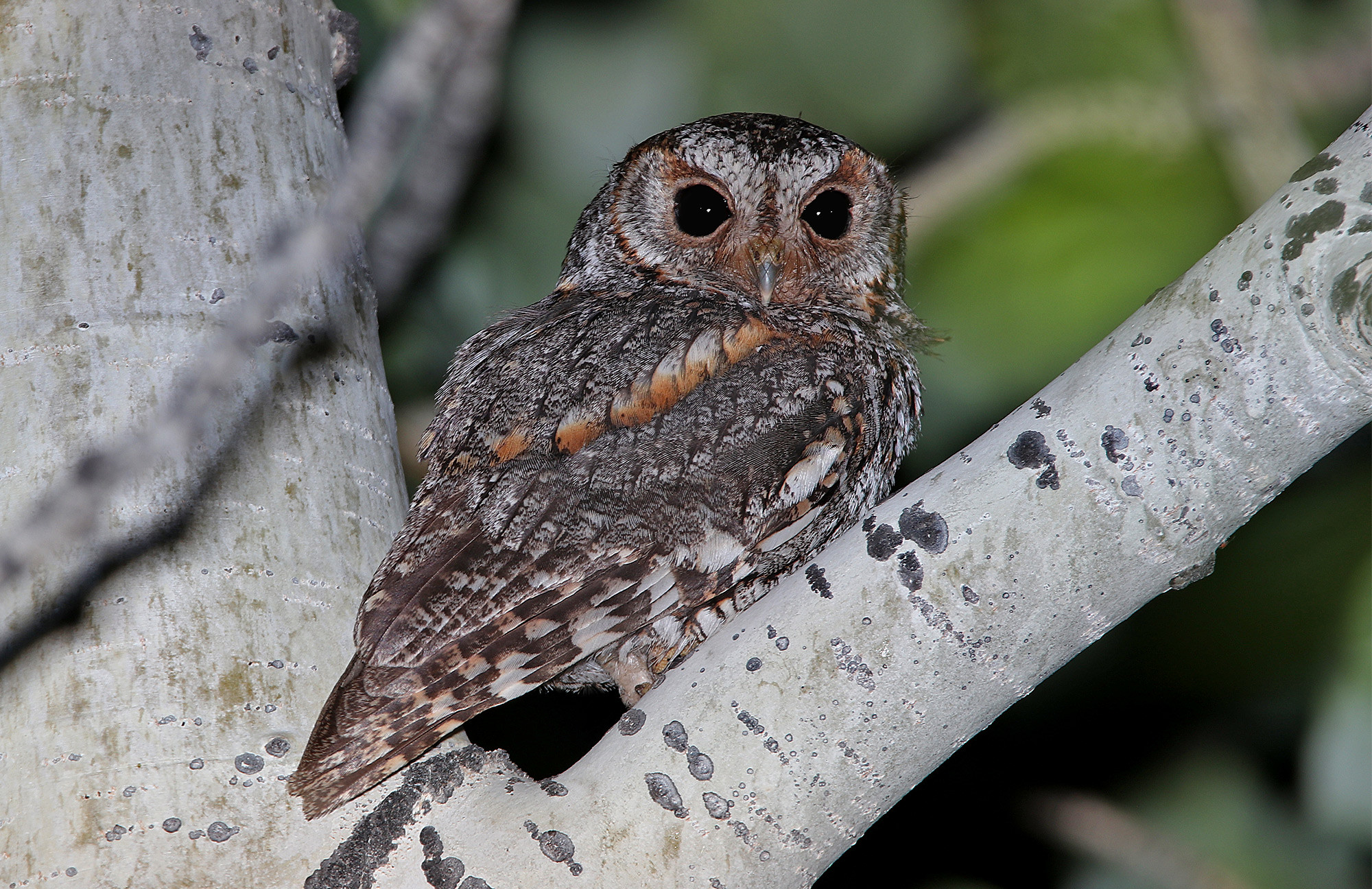 Flammulated Owl
reward on this cold June night!
After our late night, we got started a little later than usual the following morning, and that was okay. We headed to the juniper woodland and shrub-steppe about an hour from Salt Lake City to see what sage and juniper specialists we could turn up. As usual, our success rate here for the 2 main targets of
Gray Vireo and
Gray Flycatcher remained high with both birds present in decent numbers. We also picked up
Sagebrush Sparrow,
Black-throated Sparrow,
Brewer’s Sparrow,
Juniper Titmouse,
Bushtit, and
Blue-gray Gnatcatcher.
 Sage & Juniper Highlights
from our morning in the desert
We spent the remainder of the morning birding around the towns of Eagle Mountain and Cedar Fort hoping for some good raptor finds. While we had the expected
Swainson’s Hawks, nothing unusual was to be found. After lunch, we took a much-needed afternoon break. I had received a poor review of the planned afternoon outing from another guide who took a group a few days before and let us know the birding had been very slow. With not many options, and wanting to get our group in the field and to cooler temps, we headed to Alta and the weather was definitely a pleasant departure from the valley heat. While it wasn’t overly birdy, we worked hard and picked up a few montane species, including this gorgeous
Hairy Woodpecker that might have gotten into a sap mess that stained it more brown than usual!
 Hairy Woodpecker
with an awful lot of color
Trying to avoid a repeat of the night before, we ate dinner a little early and headed to our waterfall viewpoint about 45 minutes early to make sure we got the spot. It paid off! Eventually, we spotted a group of
Black Swift swirling in the distance. I counted what appeared to be 8 birds before we settled on 5 for sure as they moved down the canyon and disappeared. It was a thrilling juxtaposition from the previous day!
With the swifts in the rearview, we turned to another local owl species and took off for a short hike right after sunset. While the birds initially gave us a little heartburn, we finally tracked down one very cooperative
Western Screech-Owl that posed for the group before disappearing back into the woods. Tonight everyone in the group could be in bed by 11 pm!
 Western Screech-Owl
providing killer looks
We had an ambitious plan for Saturday—and it proved overly ambitious for a group of this size. One thing to always think about when planning any larger group tour is the added need for multiple restroom stops throughout the day, more time when viewing birds to make sure everyone gets scope views of every bird they want to see, and the added loading and unloading times. It had been several years since I did a tour this large, and I definitely didn’t plan for enough time to fit in all our stops as planned.
 Mule Deer
taken with a cell phone
We kicked off the day about 30-minutes from Salt Lake City at a montane riparian area that is generally very birdy all summer long. This morning was no different. We got right into our targets, getting cooperative
Willow Flycatcher,
Lazuli Bunting,
Belted Kingfisher,
Gray Catbird, and one member of the group spotted a distant
Black-headed Grosbeak which provided great scope views.
Moving on, we visited a mountain valley with a large agricultural area. We quickly found our main targets here of
Bobolink,
Savannah Sparrow,
Wilson’s Snipe, and
Sandhill Crane. A surprise
Wilson’s Phalarope was here—the female bird might have been an early migrant, but could have potentially been a breeder which would be an exciting find here!
 Bobolink
performing its flight song
Eventually, we made our way up in elevation visiting another montane riparian location with more mature trees and a variety of mixed habitats. In a short 45 minutes here we nabbed our main targets of
American Dipper,
Hammond’s Flycatcher, and
Red-naped Sapsucker.
 Hammond's Flycatcher
peering down at our group
We also had incredibly cooperative
Cordilleran Flycatcher,
Western Tanager,
Lincoln’s Sparrow,
Fox Sparrow, and all the typical montane species for the height of the breeding season.
 Western Tanager
belting out a tune
By the time we reached our next stop the day's plans started to unravel. Being a Saturday we anticipated crowds, but it was on the absurd level this morning. But, the campground we planned on birding was quiet as could be for the first time all month. We left adding a few species like
Cassin’s Finch,
Mountain Chickadee,
Dark-eyed Junco, and a flyover
Osprey. But we missed every specific target planned for here, putting a bit of a damper on my expectations.
 Dark-eyed Junco
at 10,000'
We did make a quick stop at just over 10,000’ for the views and picked up
Rock Wren and
Mountain Bluebird before starting our descent into Wyoming. Needing to make a quick bathroom stop we pulled into a campground on the north slope of the Uinta Mountains that I had never visited before. The 15-minute stop turned into a 53-minute outing, spurred by what appeared to be a Northern Goshawk flying through the trees. The real highlight was finding a pocket of
Wilson’s Warbler that appeared to be breeding here.
 Wilson's Warbler
we found in the Uinta Mountains
The campground was extremely birdy and we got great looks at a number of species including
Red-naped Sapsucker,
Dusky Flycatcher, and
Cassin’s Finch. We snagged one last surprise before we left as an early migrating male
Rufous Hummingbird flew past while we were gawking at Wilson’s Warblers. From here, we grabbed a late lunch in Evanston, Wyoming, before dropping back into Utah. A short stop near the town of Echo added
Golden Eagle,
Peregrine Falcon, and
Virginia’s Warbler for the tour.
 Peregrine Falcon
soaring overhead
With a big day to follow we took an afternoon break back at the hotel before grabbing dinner at a distillery nearby. After dinner, an impromptu drive through a local neighborhood added
California Quail and
Lesser Goldfinch for the week!
 California Quail
in a local neighborhood
On Sunday we rose early and made it to Antelope Island State Park for sunrise. Despite a concerted effort we missed Chukar which has been hit or miss in recent years due to a tough winter 3 years ago. We did however add
Burrowing Owl,
Great Horned Owl,
Northern Mockingbird,
Loggerhead Shrike,
Sage Thrasher, and
Rock Wren before leaving the island. Along the famed Antelope Island Causeway, we got a sneak peek at fall migration, with
50,000 Wilson’s Phalarope swarming, and
10,000 Eared Grebe dotting the water as far as the eye could see.
 Wilson's Phalarope
on the Great Salt Lake
The plan for the rest of the day was to reach the South Hills of Idaho and see if we could get our 3 main targets there before dark. We made a pit stop at the Juniper Rest Area just over the Idaho border and picked up
6 Juniper Titmouse and a singing
Bewick’s Wren!
 Juniper Titmouse
up close and personal
Expecting a quick lunch stop we were stunned to arrive at an absolutely slammed rest stop—this delayed our arrival and we didn’t make it into the South Hills until after 1:30 PM. As we drove past the Magic Mountain Ski Area, I heard the familiar call of a
Cassia Crossbill. We pulled in and spent the next hour birding the area and were treated to great scope views at several!
 Cassia Crossbill
in the South Hills
 Cassia Crossbill
we found dead in a parking lot
With the crossbill picked up, everything else in the parking area was a bonus. Eventually, we headed towards Brockman’s, but not before a quick stop in an old burn treated us to
3 Lewis’s Woodpeckers. Normally this is the highlight of the drive to the feeders, but a short distance later we found an adult
Ruffed Grouse standing in the road—and her 14 chicks that crossed while we watched!
 Ruffed Grouse
crossing the road in the South Hills
It was almost 4:30 pm when we arrived at the feeders, and we were treated to the usual show of
Broad-tailed Hummingbird and
Black-chinned Hummingbird. The star of the show as usual here though were
6 Calliope Hummingbirds that made for a great viewing opportunity as birds came in time and time again to specific feeders.
 Calliope Hummingbird
at Brockman's
Having accomplished our goal for the day we headed out through the desert towards Twin Falls. A late dinner at
Jasmine Thai was a perfect end to the day—capped off with a flyover
Common Nighthawk in the parking lot. Monday started with a visit to the agricultural areas south of town. As with 1/2 our visits to the fields this summer, we missed Gray Partridge—a disappointing change from our success here the previous 5 years. Luckily, the
Northern Harriers,
Swainson’s Hawks, and
Barn Owls put on a show to keep things interesting!
 Barn Owl
near Twin Falls
We wrapped up our time in Idaho with a visit to Shoshone Falls Park. Overall species density was really low this morning. We didn’t have any wrens which is extremely unusual, and only a single
Yellow-breasted Chat and
Bullock’s Oriole. We had to make some slight adjustments to our end-of-tour plan since several people had their flights moved up by airlines. We ended with a great lunch back in Salt Lake City, and dropped off 1/2 the group for flights. The rest of us headed to a nearby Wildlife Management area and spent the rest of the afternoon checking out
Western Grebe,
Clark’s Grebe,
Greater Yellowlegs,
Neotropic Cormorant,
Blue-winged Teal,
Ruddy Duck, and a variety of other typical marsh birds.
In just 5 short days we tallied 156 species, a surprise with such a large group, but a trend we saw this summer on most of our tours. We had low densities of birds in general, but high species counts overall. The
Lake-Cook Audubon group was a joy to bird with, and Jeff Bilsky did a phenomenal job on his first large multi-day tour!
Photos from this Tour:
Birds Seen on this Tour:
Labels: Black Swift, Cassia Crossbill, Flammulated Owl, Gray Vireo, Idaho, Sagebrush Sparrow, tours, utah
January 21, 2021 - From Salt Lake City, Utah
I don’t lead very many domestic tours in the winter. Typically after September and before May, I might lead 2-3 torus each year in northern Utah. Generally, these are 1/2 day or day trips where a client happens to be in Utah for something else and wants to maximize their time. I don’t really advertise much in the way of winter tours as there hasn’t been as much interest in the past—but I likely am missing out on some opportunities (Rosy-finches, gulls, and raptors come to mind). In any event, this past week I led what will likely be the only winter tour I do this year due to the pandemic, and it turned out to be a pretty good day.
My client, from Minnesota, was looking for a chance to pick up a few lifers while in town helping family during an adoption. With a small target list including some difficult to find birds, I recommended an itinerary that I thought could maximize our time, and also shared some self-guided information to help them outside of our tour on more far-ranging species. If you book a specific tour with me but need help finding some other birds, don’t hesitate to ask—I can usually provide a few options to help you on your quest.
For our day trip, we would start at Antelope Island State Park, then visit a few sites along the Great Salt Lake before trying for a vagrant sparrow, and pygmy-owl to wrap the day. But like so many private tours, we shifted gears and changes course early on as we started birding.
At the state park, we quickly located the first target—
CHUKAR, as we found a flock of around a dozen birds just after sunrise. Quick tip, as of late early morning has been the most reliable time to find Chukar almost anywhere in Utah. After the rough winter in 2018-19, this species has generally been much less common, and often quite difficult to track down mid-day. Following our success with the Chukar, we turned towards wrens but struck out on that front (Rock is usually reliable, and I had a Canyon while scouting earlier in the week). Instead, we managed to locate a
SAGEBRUSH SPARROW—a bird I had only seen a couple times prior in the winter along the Great Salt Lake. While this species is generally rare on the east and south sides of the lake, it is extremely rare in winter. A pretty good bird, and a surprise lifer for my client.
 |
| Sagebrush Sparrow at Antelope Island State Park |
After leaving the park we immediately adjusted the route for the day to go look for a recently reported Mew Gull in Weber. We ended up dipping here, but it put us within 30-minutes of Lewis’s Woodpecker, a target we earlier chose to skip, but with it being about 20 minutes closer, we decided to go for it—and located 3 LEWIS’S WOODPECKERS almost immediately upon arriving at the woodpecker spot. 3 lifers by 11:00 AM.
We got back on track and made our way to Farmington Bay WMA, which is a worthwhile stop any time of year. Today was no different and we hit the gull jackpot with 7 species. We missed Mew Gull, which ironically had been reported earlier in the day, but managed to pick up GLAUCOUS GULL, and GLAUCOUS-WINGED GULL, 2 more unexpected lifers.
 |
| Digiscoped Glaucous Gull at Farmington Bay WMA |
We also saw loads of AMERICAN AVOCET, a decent number of GREATER YELLOWLEGS, lots of PIED-BILLED GREBE, and the most NIGHT-HERONS, BALD EAGLES, and NORTHERN HARRIERS my client had observed at one location. The sunny weather made for great photo ops and this GREAT BLUE HERON hunting on the road was a fun stop on the way out.
 |
| Great Blue Heron hunting along the road at Farmington Bay WMA |
We decided to skip the vagrant sparrow which hadn’t been seen in a few days and my client had tried for a couple times already. Instead, I wanted a slam dunk lifer so we headed towards Park City and a feeder where I knew CASSIN’S FINCH would be present, and they did not disappoint. We also added STELLER’S JAY for the day and a handful of other montane birds.
Still wanting to look for Pygmy-Owl I laid out some options. We decided to try for a Yellow-billed Loon that had been present for more than a month now and was on our way to a reliable owl spot. But with the warm weather the past week there was a lot more open water on the lake, and with little time to search for the loon we dipped. Wanting to leave plenty of time for the owl search we made our way to a stakeout, where unfortunately despite trying for an hour we were unable to locate any pygmy-owls. This bird is tough year-round, but in the winter they often stick to the same general area for weeks. Alas, the only interesting bird in a tree we saw was more than a dozen WILD TURKEY that flew into some nearby conifers to roost for the night.
 |
| Sunrise over the Great Salt Lake |
The day started off with a fantastic sunrise, as we drove over 250 miles on the day and racked up 58 species of birds. Not the biggest list, but no less than 6 life birds, and a few pretty good finds for Utah in January. We did all of this in 2 vehicles, masked up, and socially distanced throughout the day to do our part to help stop the spread of Covid-19 but still connect and share a wonderful outdoor experience.
Labels: Glaucous Gull, great salt lake, gulls, Sagebrush Sparrow, sunrise, tours, utah
August 7-10, 2020 - From Salt Lake City, Utah
After all the cancellations due to Covid-19, I managed to put together one last tour in early August—the goal was to basically cover the Most Wanted species, with the exception of the desert species typically covered at the beginning of the most wanted tour. For this trip, I picked up a client in SLC then drove north to Twin Falls (backward from my normal route) and met up with the other 2 joining our party for the rest of the tour.
The first task was tracking down
Cassia Crossbill, which only took about 10 minutes. We found a few birds moving around the treetops and calling near Diamonfield Jack and with everyone satisfied with the views, we deiced to check a few other areas—but didn’t get any better looks, so we moved on towards Brockman’s Feeding Station. En route we picked up our obligatory
Lewis’s Woodpeckers, and also the first
Olive-sided Flycatcher we’ve recorded in Idaho on this tour.
Cassia Crossbill in the treetops
At the feeding station, there were far fewer birds than earlier in the summer, and the Black-chinned Hummingbirds were dominating the action. A good number of Broad-tailed Hummingbirds were in the mix and we had one aggressive Rufous Hummingbird that kept everyone else on guard. Of course, the highlight here was 3 Calliope Hummingbirds—all young/female types, the males appeared to have moved on.
Calliope Hummingbird mobbed by a Rufous Hummingbird
We spent the evening south of town in the agricultural areas, picking up Barn Owl and Burrowing Owl. We were watching a harrier fly over the sagebrush at one stop when a large flock of Gray Partridge took flight--this bird was tough this year on both tours! Perhaps the most interesting thing was a flyover pluvial plover that sounded like a Black-bellied or possibly Pacific Golden-Plover. Unfortunately, it never stopped and was left as plover spuh!
The next morning we birded along the Snake River where a nice flock of Bushtit provided killer views, while Canyon Wren and Rock Wren both showed nicely as well. A lingering Bullock’s Oriole was a nice surprise.
Killer looks at Bushtit
Heading south into Nevada, we stopped in Jackpot to check out the golf course and sewage ponds (very difficult to bird). 45 Killdeer were in a soccer field on the outskirts of town, while a pair of Say’s Phoebe represented a species we tend to miss about 50% of the time. Continuing south towards Elko, we stopped at a reliable Sagebrush Sparrow spot and had 9 birds!!! It was incredible seeing 6 lined up on a fence together.
6 Sagebrush Sparrows lined up!
After getting to Elko and settling in we headed off in the later afternoon to bird along the Humboldt River. We had an incredible outing with 38 species, the second-biggest total in eBird from this area. While there was nothing too remarkable, we had a Mallard type that gave us fits as a possible Mexican Duck and in the end, left us with more questions than answers.
We wrapped up the day at South Fork Recreation Area and a nice assortment of shorebirds and the hit or miss resident Bald Eagle. Early to bed, we got up early due to the experience on my previous tour and were at the trailhead at 3:22 AM. Hiking in the dark while serenaded by a Great Horned Owl, I moved at a pretty good pace for a big man. Talking to the group beforehand I told them I wanted to be in place well before sunrise so I would go ahead and get setup. I was at the lake in under an hour and at my viewing spot 20 minutes later still completely dark. Slowly everyone in the group arrived and we watched the sky lighten in the east.

The last little bit of night fading to day...
At 5:20 am the Himalayan Snowcock started calling, and for a painstaking hour and thirty minutes, I scoped my usual locations without seeing anything. The birds had been silent for almost an hour when one called in what seemed like a higher than usual meadow. I moved my scope and worked my way across when I caught the movement—success! For the next hour, we followed a pair of birds that worked their way across a 1/4 mile stretch. It was a huge relief after the short look the week before!
Target achieved--Himalayan Snowcock at 60x...
The other interesting note was we had 15 Black Rosy-Finch today. I remarkable count for this tour! After an uneventful hike down we found another Lewis’s Woodpecker in Lamoille Canyon, before heading back to town. Grabbing lunch and eating in the park a Townsend’s Warbler moved around in the trees over our table—a first for the most wanted tours which generally occur well before migration for this species.
We did the same loop in the evening as the night before with what appears to be a Red-shouldered Hawk flying along the river. We never got great looks and left it as buteo spuh on the checklist. Southfork had a good amount of movement overnight with a lot more shorebirds today. We added Semipalmated Sandpiper and Greater Yellowlegs for the tour.
Our final morning started off without having to re-hike for snowcock—always a nice way to start morning 2 in Elko. We birded the desert around town and counted an incredible 25 Sage Thrashers before starting our journey back towards Salt Lake City. On a whim, we decided to check out an RV resort on the side of the freeway. I called the owners and got permission to bird and we were pleasantly surprised. There were a few migrants around—but still, on the early side, it was mostly breeders. A young Gray Catbird was the best bird—likely a breeder in the area, there are very few confirmed sightings in Elko county away from the Goshutes which get a fair amount of coverage from hawk watchers every year. For me, it was a new Nevada bird.

Gray Catbird skulking around the RV resort
For the 2nd week in a row, we had a Nashville Warbler, indicating some good early movement this year. The other bird that was briefly seen was an apparent 1Y Bay/Poll Warbler. We lost it after finding it and were unable to relocate it in the thick willows here. I know I want to bird this location later in the fall in the future—I imagine it could turn up some nice eastern vagrants!
Back in Utah, we picked up Baird’s Sandpiper at a roadside pond before finally snagging a Ferruginous Hawk at the stakeout from the previous week. Working on upping the tour total we birded Lee Kay Ponds in Salt Lake Valley for Neotropic Cormorant before breaking for a bit. In the evening we set off to look for Black Swift. It was a hot day in northern Utah and after it cooled very few swifts were out at our breeding site. We did spot a few White-throated Swift and eventually had 2 swifts that looked good for Black Swift, but were quite high, and I wasn’t comfortable making the call on birds that we couldn’t be sure about.
We wrapped the tour up with the pièce de résistance, and my favorite—the Flammulated Owl. Even weeks after breeding season, we still located 3 Flammy’s, successfully locating the big 3 for the mini most wanted.

Ending with a bang--Flammulated Owl to warp things up
After what was a really tough summer for the world, the country, the tour industry, and my company I was just happy to be able to lead some tours this year. I really enjoy the most wanted tours and it was fun to be able to show a few new birds to clients.
We ended up with 135 species for the tour and with the exception of the difficult to get swift we got every other target bird for the tour!
Photos from this tour can be found here:
Labels: Calliope Hummingbird, Cassia Crossbill, Flammulated Owl, Gray Partridge, Himalyan Snowcock, Idaho, Lewis's Woodpecker, Most Wanted, Nevada, Sagebrush Sparrow, utah
 BACK


